
Recently restored fresco's in the villa of emperor Augustus on Palatino Hill. Right wall in the middle room.
Recently
restored fresco's in the villa of emperor Augustus on Palatino Hill.
Right wall in the middle room.
The Forum Romano, “Just a heap of old stones” as children would state or a “vibrant history with victorious legions crossing the Forum Romano jeered by 100,000 people” as culture lovers would imagine through their readings. Depends on your interest, or perhaps even more, your imagination.

Forum Romano, view East at the Titus Arc.

Forum Romano, view West at the xxxx Arc.
Until 1800, the deeper parts of the 2000 year old Forum Romano were a cow pasture, flooded once in a while by the Tiber River, the silt and clay from the river covering most of the ruins except the three triumph arches, for Constantine (272-337 AD), Titus (38-81 AD) and Septimus Severus (145-211 AD).
Titus fought the first Jewish-Roman War between 67 and 70. Wiki: “Titus was left in charge of ending the Jewish rebellion, which he did in 70, successfully besieging and destroying the city and the Temple of Jerusalem. For this achievement Titus was awarded a triumph; the Arch of Titus commemorates his victory to this day.”

Old Rome, before the excavations in 1800,
View North.
The higher parts were rebuild several times since the Middle Ages, also by trying to eradicate any memory of the brutal 550 year period, from around 200 BC to 312 AD, when the Roman empire ruled the “known world”. They had “devoted Christians torn apart by lions for fun”, until Constantine made Christianity a state religion in 312 AD. Like in South America, churches were build preferentially on top of old temples, also as building material was already available.
From Wikipedia:
“An anonymous 8th century traveler from Einsiedeln (now in Switzerland) reported that the Forum was already falling apart in his time. During the Middle Ages, though the memory of the Forum Romanum persisted, its monuments were for the most part buried under debris, and its location was designated the "Campo Vaccino" or "cattle field," located between the Capitoline Hill and the Colosseum. The return of Pope Urban V from Avignon in 1367 led to an increased interest in ancient monuments, partly for their moral lesson and partly as a quarry for new buildings being undertaken in Rome after a long lapse. Artists from the late 15th century drew the ruins in the Forum, antiquaries copied inscriptions in the 16th century, and a tentative excavation was begun in the late 18th century.
A cardinal took measures to drain it again and built the Alessandrine neighborhood over it. But the excavation by Carlo Fea, who began clearing the debris from the Arch of Septimius Severus in 1803, and archaeologists under the Napoleonic regimemarked the beginning of clearing the Forum, which was only fully excavated in the early 20th century.”


The Forum Romano
The Forum Romano was the center of Rome during the Roman Empire and used for political shows like victorious legions and for a daily market of high priced goods like enslaved gladiators, either prisoners of war or volunteer citizens with a large debt that could now be payed-off by selling themselves.
The risk of dying as a gladiators was similar or even less than when you were a rural farmer. Sickness, famine by a failed harvest, passing armies or vandals reduced the life expectancy of a farmer to about 30 years. Gladiators were the sports stars of the Roman Empire and required a large investment. Life's were spared as much possible in the lower leagues but in the Champion League, played in e.g. the Colosseum of Rome, the stakes were high, so death was close. This may seem cruel and exceptional but already during the Olympic Games at the height of the Greek Civilization from around 500 to 200 BC, horse racing and free wrestling were among the most popular and the deadliest games. These sports simulated war that erupted regularly between the independent Greec “polis” or city states.
The last time I visited the area was in 1972, just 17 years old, on a low-budget hitch-hiking trip from my uncles place near Lyon through Florence and Rome to Napels. Altough small, it still looked very impressive. When I was 12 years old, I did some intense reading on the Greec and Roman era. The stories read like adventure stories and I was fasinated by their richness; reality and fiction seemed totally mixed.
26 years later I am back. This time as a speaker on a major conference, flying business class and staying in a 5 star hotel with a golf course which we used on a free morning.
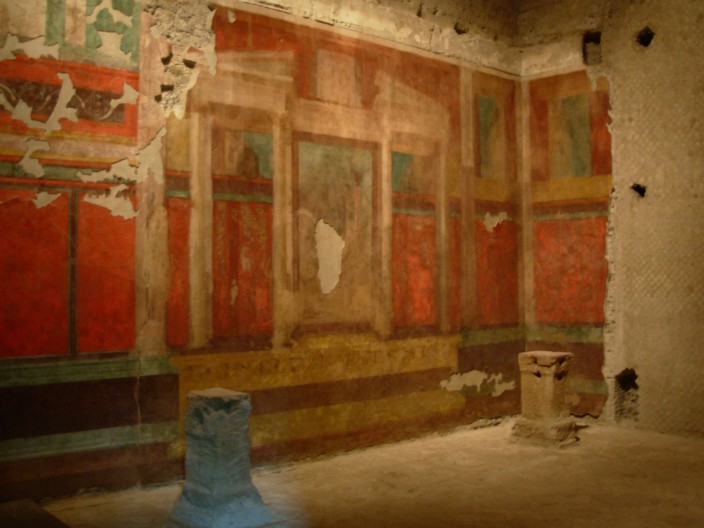
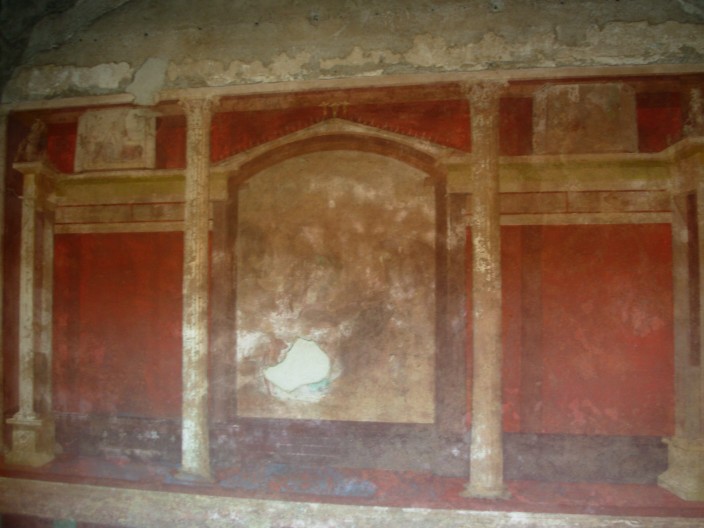
Recently, frescos in the villa of Augustus on Palatino Hill were restored and these are currently the attraction in Rome.
At 5 PM I took the bus from the hotel to the Forum which is open till 7 PM and entered the area at the Palatino Hill entrance. This has a park landscape, big trees among ruins, big red brick walls of Roman buildings up to 3-4 meters high. I found it difficult to imagine the Roman's were already using red stone bricks.
I followed the sign to the Villa Augustus which takes about 10 minutes, going left and right many times. On top you have a nice view of the forum.
The excavated villa is covered with a sheet metal roof and has only three rooms on the ground floor and a few on the1st floor. It must have been much larger originally and by the size of the sheet metal roof covering the back side, it seems the excavations are still on-going.
The villa is well visible from the forum, sitting on the edge of
the hill. This was one of many politcal trics of Octavian (63 BC - 14
AD), the adopted son of Julius Ceasar, his original name when he was
the consul of Rome. E.g. “I am always present to serve you”,
to pretend he was chosen by the people as a representative and not an
absolute ruler. After many years, he still pretended he was not an
absolute monarch, but just representing the people at their will and
would step down anytime when ordered. In 23 BC, he changed the
republic (since 509 BC) with some sort of facade democracy to an
empire with a single ruler, finally adapting the name Augustus. The
empire would survive until 476 AD in the West (Rome) and until 1453
AD in the East (Constantinople). Ironically, Augustus reign was one
of the most stable and prosperous period in the history of Rome. 
The house of emperor Augustus.

The house of emperor Augustus.
The frescos inside are impressive,
three rooms with most of the walls covered. Red and yellow colours
dominate, just like in ancient China. 
Fresco in the house of emperor Augustus, right wall of the second room.
Fresco in the house of emperor Augustus, left wall of the second room.
Fresco in the house of emperor Augustus, third room.
Fresco in the house of emperor Augustus, third room.
Fresco in the house of emperor Augustus, third room.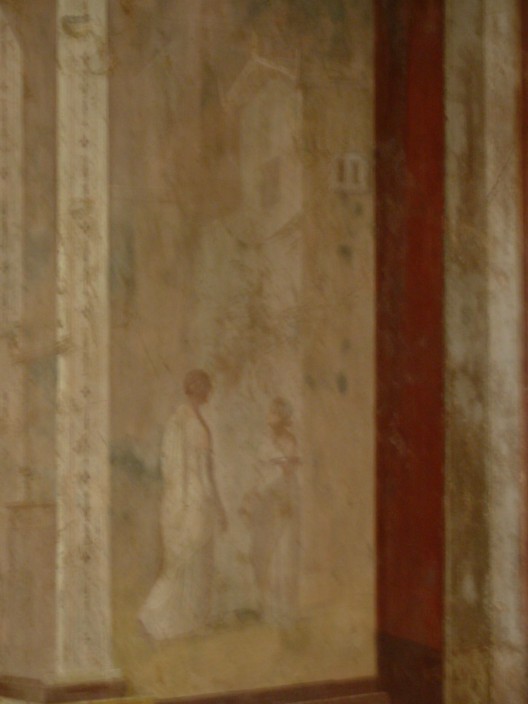
Fresco in the house of emperor Augustus, third room.

Fresco in the house of emperor Augustus, ceiling of the first
room.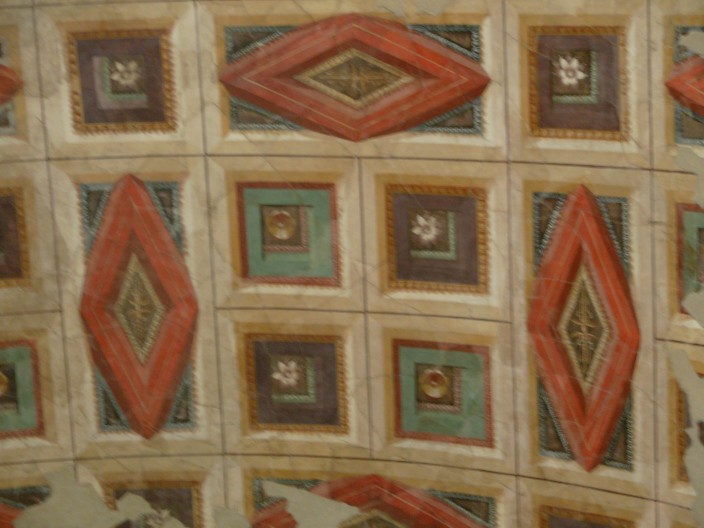
Fresco in the house of Emporer Augustus,
ceiling of the first room.
Fresco in the house of emperor Augustus, ceiling of the first room.
We visited the Villa Adriana in Tivoli during the conference dinner. See Wiki.
On the far side is an original pond and a two-story building with marble statues. Here the absence of frescos is striking, only very faint colours are still visible on the walls and ceilings.
Unfortuntely we couldn't take pictures of the marble statues with
ourselves. The picture below was taken secretly with a zoom lens from
the outside. 
Statues in Villa Adrina, Tivoli. Neptune in the back right side. Athletic young man, left side.
Neptune resembled one of my gourmet Italian speaking colleagues (except for the beard) and I tried to compare myself with some of the good looking athletic young men (left of picture), only a modest lower 90%, but this was greeted with disbelieve.
Between the airport and downtown road there is a remarkable building close to the centre along the highway with an inscription:
"VN Popolo di Poeti di Artisit di Eroi di Santi di Pensatori di Scienziati di Navigatori di Transmigratori".
Or: People of the poets, artists, heros, saints, thinkers, scientist, navigators, and migrators.
It is the Palazzo della Civiltà del Lavoro (1938-43), see e.g.

Palazzo della Civiltà del Lavoro (1938-43), a neo-Roman building built for 1942 Rome World Exhibition.